

Exploded pack, to scale (drawn from the real part)
Concept B's argument with concept D's honesty. The same pack pulls apart into four layers, except this is NB2037QE34 at true size: an 85.42 mm case, two real 18650 cells in the 2S1P array the spec calls for, and five terminals at 5.00 mm pitch.
Open concept A →
Exploded pack teardown
The pack pulls itself apart into four layers. Drag sideways to open it further, hover any layer and it tells you who makes that part — molded here, placed on our SMT line, matched and welded here, cycled before it ships.
Open concept B →
Device wall
Six device categories on the right. Hover one and the headline, the pitch, and the typical pack spec all rewrite themselves for that engineer. It cycles on its own until someone takes over.
Open concept C →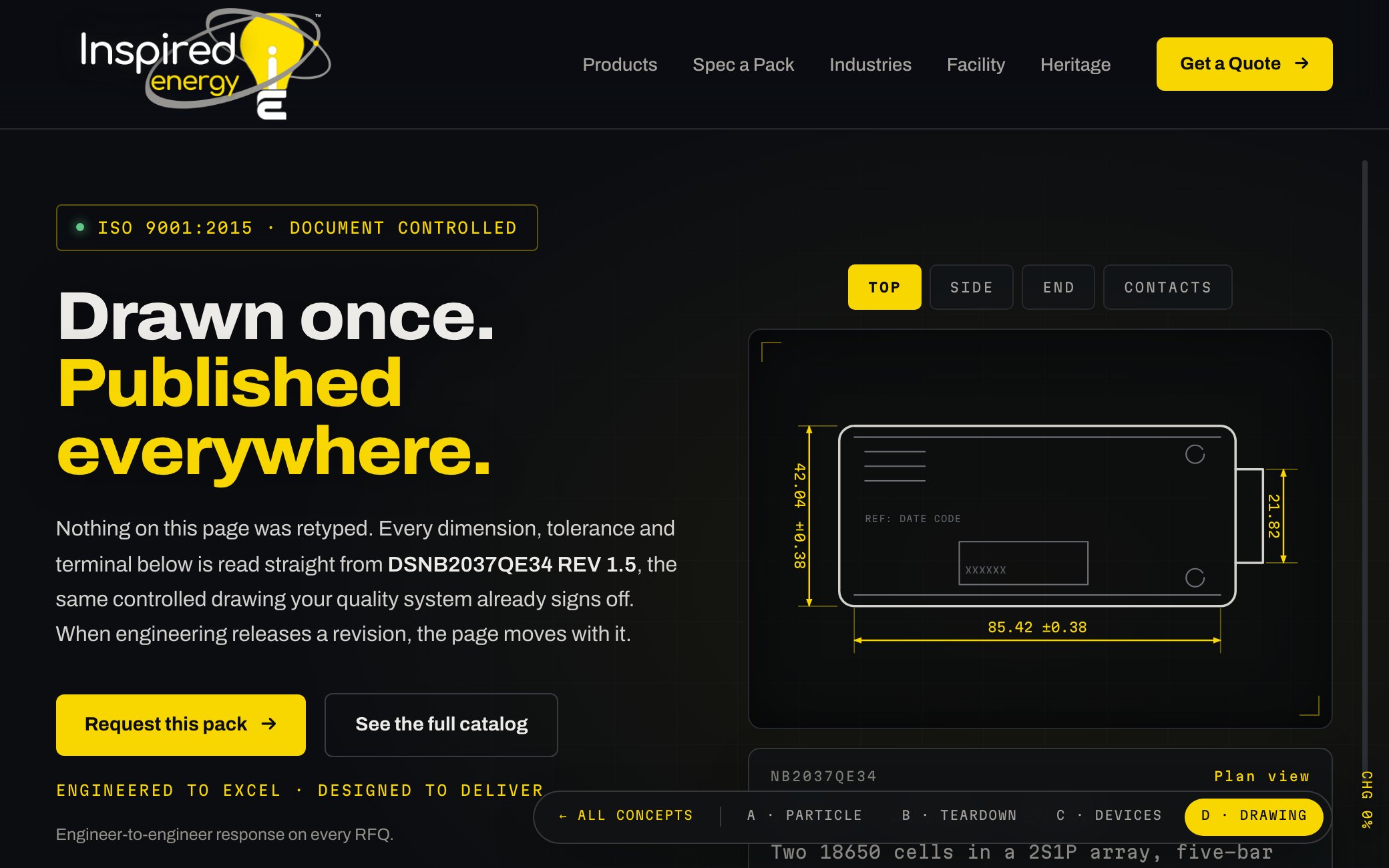
The controlled drawing
The real engineering drawing for NB2037QE34, plotting itself on screen. Step through four views, hover any callout and it reads the dimension, the tolerance and the terminal function straight off DSNB2037QE34 Rev 1.5. The hero cites its own source document.
Open concept D →
The real pack, pulling apart (rendered from engineering's CAD)
Concept B as a film, except nothing is drawn. The NH2054 assembly straight out of Creo, every case half, cell, board, strap and contact, lit like a product photograph and pulling itself apart. Pauses on request, holds still for visitors who prefer no motion.
Open concept E →Concept A, the teardown drawn to scale. It makes concept B's argument, the one a competitor physically cannot copy, using the real part instead of a generic box: an 85.42 mm case, the two 18650 cells the spec actually calls for, five terminals at 5.00 mm pitch.
Concept B is the same teardown with invented geometry. It was built first, before we had the mechanical drawing, so its pack is a generic box with four unnamed cells. The argument is identical and it is kept only for comparison. If A reads well, B retires too.
Concept C is the safer conversion play if the priority is lead volume rather than differentiation. It sorts a medical buyer from a defense buyer before they scroll, and it is the cheapest of these to finish.
Concept D is the sharpest for engineers and the one that argues the catalog project itself. It puts a real controlled drawing on the page, cites the document and revision it came from, and makes the case that what the website publishes and what engineering signed are the same numbers. It needs no sign-off: every value on it is already public on the current datasheet.